
- Diplexer for combining or splitting the two ranges 0 - 88 MHz and
136 - 1000 MHz. - Excellent wide-band coverage – usable for a lot of applications.
- Extremely small dimensions.
- Quick installation using dual-adhesive pad provided.
- FME-connections on all terminals.

Description
Specifications
| Electrical | ||
|---|---|---|
|
||
|
||
|
||
|
||
|
||
|
||
| Mechanical | ||
|---|---|---|
|
||
|
||
|
||
| Environmental | ||
|---|---|---|
|
||
Ordering Designations
| Model | Product No. | |
|---|---|---|
| DIPX 88/136 | 200000659 |
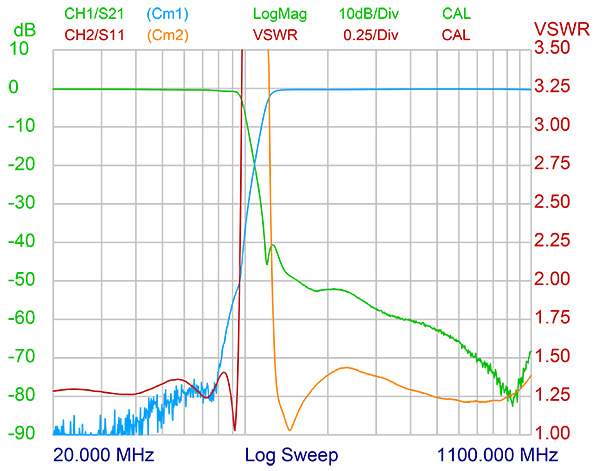
Typical Response Curve
INSTALLATION
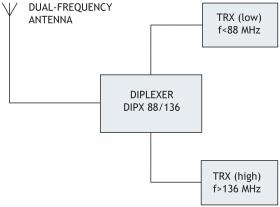
The DIPX 88/136 makes it possible to use only one antenna for the operation of two transceivers (one in each range). See the figure below. The antenna must be a dual-frequency antenna, that is, it must be resonant on the actual frequencies in the two bands.
The transceivers may be used independently and will have no degrading influence on each other. Typically, the diplexer is installed next to the transceivers and only one cable is used between the diplexer and the antenna. The diplexer is suitable both for base station and mobile use.
The main tasks of the diplexer are to protect the individual receiver input from being destroyed by the transceiver in the contrary band and to ensure a low-loss path between the transceiver and the antenna which is not loaded by the other branch.
The diplexer can be operated together with any set of transceivers operating within the 0 - 88 MHz and 136 - 1000 MHz frequency bands.
Dual-frequency antennas are available for both mobile and base station applications.
Related products

Power Splitters and Dividers
Power Dividers and Splitters in 2-4-way configurations. Max. power up to 500 W in frequency range 70-2700 MHz. Read more.

Mounting Kits for Filters
Amphenol Procom provides Mounting Kits for a wide range of Multiplexers and Duplex Filters with repeater. Learn more of our product line here.
Multiplexers
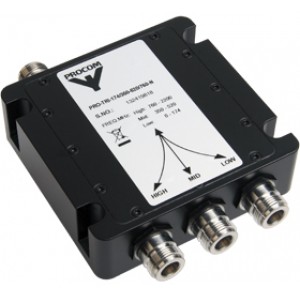
RF Multiplex Filters portfolio by Amphenol Procom consist of quality Triplex Filters and Quadroplex Filters with high performance. Learn more here.
