
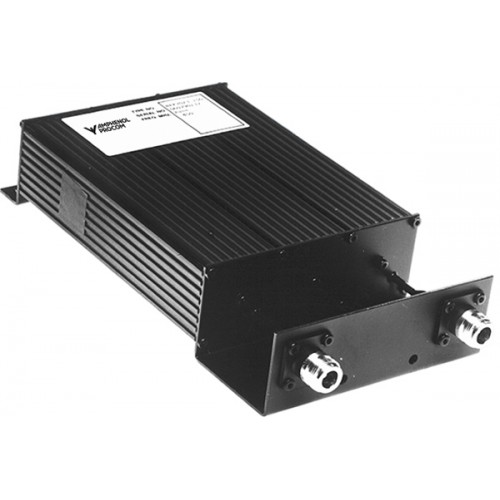
- This band-pass filter is mainly applied to prevent interference between transceivers with narrow frequency spacing which are operating on antennas installed very close to each other.
- One of the transmitters may cause intermodulation in the output amplifier of the other transmitter, or the presence of one transmitter might “block” the contrary receiver or desense it because of excess sideband noise.
- The BPF 70/3-150 consists of 3 full-size quarter wavelength cavities with adjustable capacitive coupling between the resonators. This filter is applied when other available band-pass filters or pass-reject filters do not provide adequate power handling capability, or lack in attenuation at narrow separations.
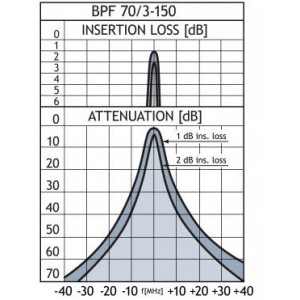
- The filter has a very steep rolloff between the pass-range and the stop-band. This rolloff can be made even steeper by sacrificing on insertion loss. This “trade-off” may be necessary by very small separations or by highly required stop-band attenuation. Please note that the full power rating of 150 W can only be kept when keeping insertion loss below 1 dB. If insertion loss is raised to 2 dB, maximum allowable input power is 75 W.
- Another feature of this filter is its ability to be tuned with a certain pass-range bandwidth.
- The housing is made of extruded aluminium, the chassis of passivated steel, and teflon insulation has been used in the coaxial cables and in the connectors.
- The filter is coated with black vinyl to prevent corrosion.
Band Pass FiltersBPF 70/3-150
Highly Selective Band-Pass Filter for the 450 MHz Band with High Power-Handling Capability (150 W)
Description
Specifications
| Electrical | ||
|---|---|---|
|
||
|
||
|
||
|
||
|
||
|
||
|
||
|
||
| Mechanical | ||
|---|---|---|
|
||
|
||
|
||
| Environmental | ||
|---|---|---|
|
||
Diagram and Mounting
TYPICAL RESPONSE CURVES
Ordering Designations
| Model | Product No. | |
|---|---|---|
| BPF 70/3-150-N(f) | 200000926 |
Ordering Information
The BPF 70/3-150 is delivered factory tuned. Depending on the nature of the problem the band-pass filter has to solve, please specify the relevant of the following data when ordering: Centre frequency, operating frequency of disturbed or disturbing transmitter, required attenuation at stop-frequency, tolerable insertion loss and, optionally: pass range bandwidth.
Typical Response Curve

Related products
Band Reject Filters
Amphenol Procom’s portfolio of HF, VHF and UHF Band reject Filters works with input power up to 350 W and are customizable. Read more.

High Pass Filters
High Pass Filters by Amphenol Procom are highly used for protection of PMR, DMR and LMR radio against high power television or FM broadcast radio systems.

Low Pass Filters
In Amphenol Procoms Low Pass Filters the spectrum of pass band are from 0-2100 MHz and stop band from 138 MHz to 12.4 GHz. View our products line here.

Mounting Kits for Filters
Amphenol Procom provides Mounting Kits for a wide range of Multiplexers and Duplex Filters with repeater. Learn more of our product line here.